
How to Create an Ergonomic Macrame Workstation in Small Spaces

Setting up a dedicated ergonomic macrame workstation makes a massive difference in knot consistency, tension control, and body comfort—especially when crafting plant hangers, which require vertical drop clearance.

1. Choose Your Vertical Anchor System
Unlike flat macrame items like wall hangings or coasters, plant hangers must be knotted vertically. Knotting flat on a table results in uneven tension and twisted cords once the hanger is suspended under load.

Option A: Rolling Clothing Rack (Most Versatile)
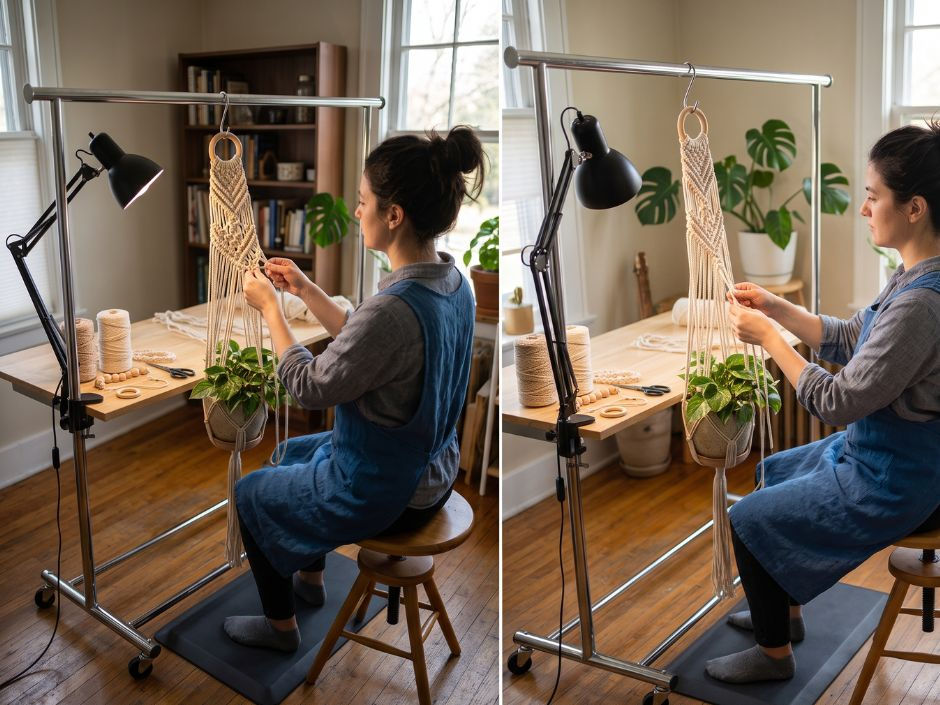
A heavy-duty metal garment rack gives you 360-degree access to your work and portable mobility around your space.
Why it works: You can adjust height, use large S-hooks to hold wooden rings, and walk around your piece to check symmetry.
Pro tip: Anchor the bottom base with weight (or lock the wheels) so the rack doesn't wobble when pulling tight square knots.

Option B: Door-Mounted Rack or Over-Door Hooks
If space is limited, an over-door organizer or sturdy coat hook mounted to a solid core door works well.
Why it works: Utilizes zero floor space while keeping the project at eye level.
Pro tip: Place felt pads on the back of hooks to prevent door scuffing during vigorous knotting.

Option C: Ceiling Hook or Tension Rod
A heavy-duty ceiling eye-bolt placed in a joist or a heavy-duty shower tension rod set inside a door frame.
Why it works: Provides maximum height clearance for long-drop plant hangers (40–60+ inches).

2. Essential Tools & Materials Checklist
Keep your core tools within arm's reach to maintain a steady rhythm.
Tool | Purpose in Plant Hanger Crafting | Key Selection Criteria |
Heavy-Duty S-Hooks | Connects the wooden/metal ring to your anchor point | 3" to 4" steel hooks with rubber ends |
Sharp Fabric Shears | Trimming thick multi-strand cord cleanly | Ultra-sharp stainless steel, dedicated to fiber only |
Flexible Measuring Tape | Measuring long cord lengths and equal tail drops | 100" flexible tailor's tape |
Cord Organizer / Bobbins | Manages long working cords (12–20 ft per strand) | Silicone cord wraps or butterfly folds with rubber bands |
Sample Nursery Pots | Testing basket sizing during knotting | Keep 4", 6", and 8" plastic pots handy |

3. Workstation Ergonomics & Lighting
Plant hangers require repetitive arm movements and standing or adjusting position as the piece grows.
Set Your Work Height at Eye Level: The wooden ring or top gather knot should sit near eye level when starting. As you work down toward the basket, raise your anchor point or lower your seat so you aren't constantly bending over.
Task Lighting: Position a directional floor lamp or clamp light at a 45-degree angle. Side lighting casts subtle shadows on cords, making knot mistakes instantly visible.
Anti-Fatigue Mat: If standing at a rack, use an anti-fatigue gel mat to prevent lower back strain during long knotting sessions.
4. Smart Cord Management for Beginners
When cutting cords for plant hangers, working ends can easily measure 15 to 20 feet each. Unmanaged cords tangle quickly and slow down knot speed.
The Butterfly Wrap Method: Fold long working cords into figure-eight loops around your thumb and pinky finger, then secure with a rubber band, leaving a 2-foot active working end.
Spool Placement: Keep full cord spools on the floor directly beneath your anchor point or mounted on a vertical spool holder to prevent rolling.
Weight Anchors: Use lightweight sewing clips or mini binder clips to hold bundle ends together while crafting basket gathering knots.


Comments